


Förra veckan fick jag förmånen att hålla ett ”opening statement” på ett seminarium i Stockholm med rubriken ”Coordination of Nordic Building Regulations” i egenskap av ordförande för det nordiska gränshinderrådet.
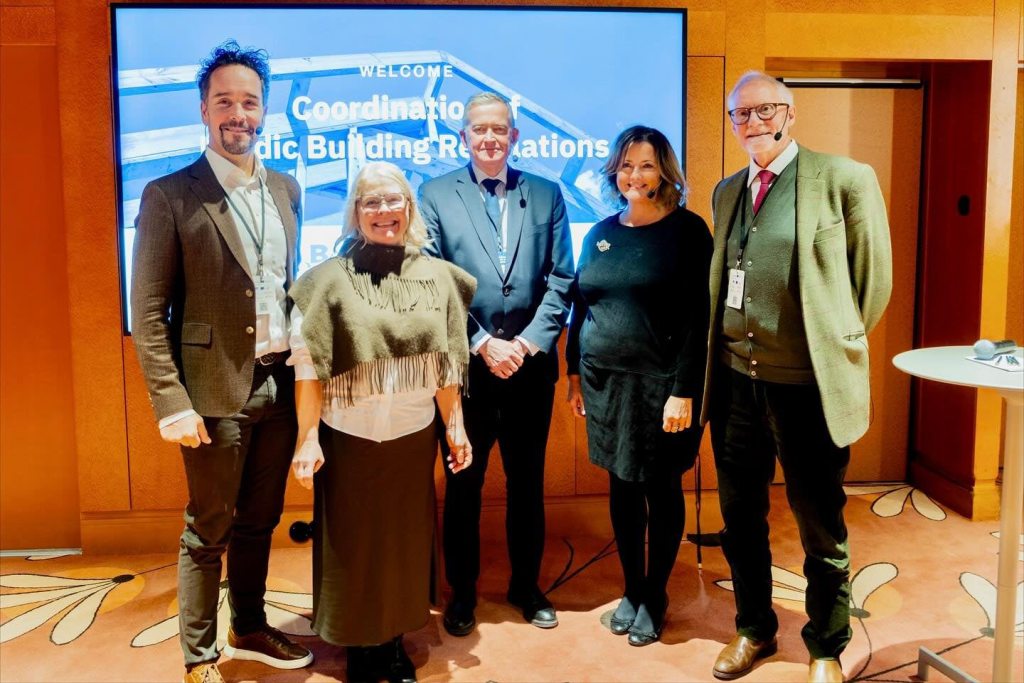
Jag sa ungefär såhär: (på engelska)
Ladies and gentlemen,
Welcome to Stockholm and to this important conference on the harmonization of building regulations across the Nordic region. It is a privilege to stand here today with so many experts, policymakers, and industry leaders who share a common goal:
To create a more integrated, efficient, and sustainable construction market in our home region.
Our Nordic countries are united by shared values, similar climate challenges, and strong ambitions for environmental sustainability. Yet, fragmented building rules and standards between countries continue to erect unnecessary barriers for companies. Especially small and medium-sized enterprises struggle to navigate different certification and approval processes.
This fragmentation slows progress, raises costs, and limits our collective ability to innovate and export Nordic solutions globally. It is also a missed opportunity. Studies suggest that harmonized building regulations could save the Nordic construction sector substancial amounts annually and significantly enhance competitiveness.
These differences do not only restrict the free movement of goods and services — they also hold back the flow of ideas, innovation and collaboration. They stop projects already at the drawing board.
The construction sector is one of the pillars of our economies. It employs hundreds of thousands of people, drives investment and shapes the way our societies grow. Yet, it is also one of the sectors with high costs and slow productivity growth. Sweden, Norway and Iceland are among the most expensive countries in Europe to build in, and Finland and Denmark are not far behind.
One key reason is the lack of a common market. Different rules in each country mean that companies must re-design, re-certify and re-approve projects every time they cross a border, even though our climate, materials and safety principles are almost identical.
Within the Freedom of Movement Council, we have identified the harmonisation of building regulations as a priority this year. Just a few weeks ago, we organised a bilateral seminar in Mariehamn, bringing together representatives from Finland, Sweden, and Åland. The aim was to explore Åland’s unique position.
Åland, which I am proud to call my home, holds legislative authority over its building regulations. We use a legal framework that blends Swedish, Finnish, and local Åland legisaltion to be a kind of Nordic legal hybrid version.
This unique position makes Åland a perfect place to test different proposals – a place where good intentions are not just talked about, but can be put into action. In Åland we can demonstrate that harmonisation is indeed possible, we can take the best from Sweden and Finland and make it work for us in Åland. And if it works for us, why would it not work in the rest of the nordics.
The truth is that progress in the nordic countries has been slow. Despite decades of discussions, real harmonization has not happend. And part of the reason is this: The devil is in the details.
We often agree on the big picture and principles. On safety, sustainability and accessibility. But diverge on seemingly small differences: how wide a staircase should be, which way a door opens, or how much space is required in a bathroom for accessibility.
These details, while technical, have real economic consequences. They can derail projects, increase costs, and prevent prefabrication and industrialized construction from scaling across borders. In Mariehamn we discussed that another faster way to reach the target of a more integrated market could be. Mutual acceptance. Be that countries, in selected areas, could accept each other’s building standards as equivalent.
We need to trust each other’s systems and recognize equivalent outcomes, even when technical approaches differ. Accepting other countries regulations where they meet the same functional goals is a practical way to reduce friction without lowering standards.
And at the same time, it would open the path to deeper harmonisation later on.
If we succeed, we won’t just build houses, we’ll build trust, and build a Nordic region that sets the standard for smart, sustainable construction. I really hope this day will result, not just in the form of another vision, but as a practical path forward, where pilot projects and cooperation lead to real change.
Thank you, and welcome to what I hope will be an inspiring and productive day of dialogue and collaboration.
 Fredrik Karlström